Are You Capitalizing on Your Investments?
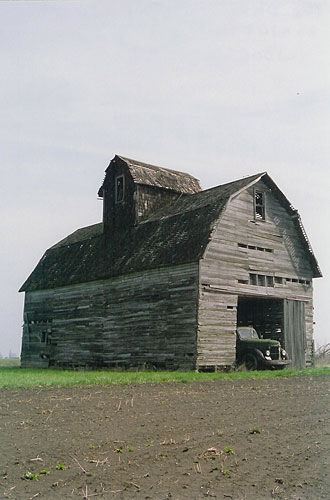 Wandering
America’s back roads is fascinating; a study in contrasts to observe how the way people live is influenced by past history
and present circumstances. When my husband and I travel, we take note of the style of buildings, their care, and the accumulated
stuff that can easily clutter the landscape around them. I wince at the sight of a neglected barn. He looks longingly at
antique vehicles rusting away beside it.
Wandering
America’s back roads is fascinating; a study in contrasts to observe how the way people live is influenced by past history
and present circumstances. When my husband and I travel, we take note of the style of buildings, their care, and the accumulated
stuff that can easily clutter the landscape around them. I wince at the sight of a neglected barn. He looks longingly at
antique vehicles rusting away beside it.
Not everyone has the health or the resources to do as they might like in maintaining property so it is unfair to be judgmental. But extenuating circumstances aside, the fact remains that, far too often something of value is being allowed to waste away. Who would let hundreds or thousands of dollars in actual cash lay about to deteriorate in the weather?
Spring is a perfect time to reassess what we have and what to do with it. The Internet can be a great source of information to support creative thinking. Never assume, for example, that old horse-drawn farm equipment has value only as scrap metal. There are Amish farmers, nonprofit groups, and people who farm and/or compete with horses who may have use for it. My husband, a friend, and I teamed up to rescue a trailer-load of horse-drawn equipment from a scrap yard and donated it to Tillers International in Scotts. (Tillers is a nonprofit organization that, using horses and oxen, teaches sustainable agriculture to people from around the world) The same day we rescued the farm equipment, we learned that a 1940s bulldozer had been cut into pieces before anyone thought to check the Internet to see if it had collector value. Suffice it to say, someone had significant monetary regrets.
Old lead-glass windows, ornate metal work, carts, casters, old staircases, wagon wheels, and an endless array of “stuff” can have value. A neighbor recently gathered up two loads of things from his property, hauled it to a sale, and came home several thousand dollars wiser.
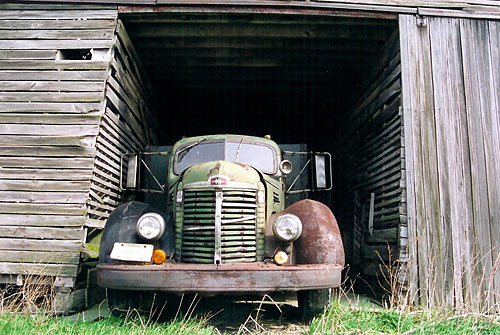
For many years, this old truck sat half in and half out of a lonely Ohio corn crib barn.
Then, suddenly everything was gone and only a flat field remained.
Heritage barns have value, if no longer for agricultural use, then for adaptive reuse. The Internet abounds with websites where barns can be bought and sold, often being moved several states to become studios, homes, and businesses. But for the barn to retain its greatest value it must be kept in reasonable repair. A few loose shingles or metal roofing can be repaired at minimal cost. But when the hole widens, the rain pours in, the flooring and frame are compromised, the foundation washes away, a building with thousands of dollars in potential value is wasted. Vines may look quaint climbing the siding, but they are terribly destructive. Tree roots growing into a foundation spell disaster as do rodents and wood-eating beetles and ants. Many barn preservation organizations, barn wrights, books, and websites provide advice on diagnosing and correcting problems.
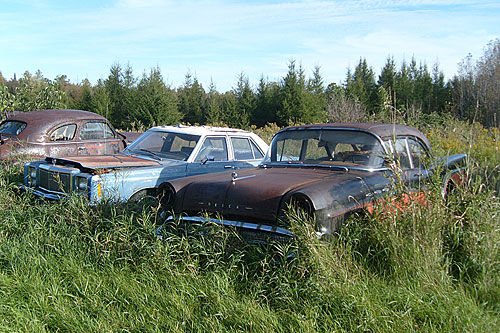
A row of autos rust away behind a Michigan barn.
There is a growing need for people who understand old barns to undertake the repair and/or straightening of frames, adapting to new farm or alternative use, dismantling, moving, and reconstructing them. Some barn wrights and timber-framers are eager to take on apprentices committed to learning the techniques of this traditional trade. The Internet offers resources. At the minimum, if a barn cannot be saved, then the best of its wood should be salvaged to help save another barn if possible or to be reused. A new Michigan-based company that specializes in reusing barn wood first encourages people to save the barn if possible and takes it down only as a last resort, reusing everything possible in the process.
There is great truth to the expression that one man’s junk is another man’s treasure. But it cannot be a treasure to anyone if it isn’t taken care of. There is no time like the present to capitalize on your own investment.
Jan Corey Arnett©2011